Presenting Our Research at ECCV 2026 in Malmö
Sarthak Pandey and Shreshth Rai travelled to Malmö, Sweden, to present two of our lab's papers at the ECCV 2026 CDEL Workshop, and spent the week connecting with researchers from around the world.
Earlier this year we announced that two papers from our lab had been accepted at the ECCV 2026 CDEL Workshop (Computer Vision for Data Curation, Efficiency & Learning). This September, lab members Sarthak Pandey and Shreshth Rai travelled to Malmö, Sweden, to present that work in person at ECCV 2026 (September 8–13).
The conference
The European Conference on Computer Vision is one of the premier venues in the field, with a week of keynotes, oral and poster sessions, and workshops on emerging research directions. The CDEL Workshop focused on how training data is selected, curated, and compressed, and how those choices shape what models learn, making it a natural home for our lab’s work on data curation.
Presenting our work
Both papers were presented as oral presentations at the workshop, followed by poster sessions where we walked attendees through our results and answered questions.
MedCurate-Bench: Auditing the Diagnostic Validity of Curated Medical Image Datasets
Authors: Sarthak Pandey, Shreshth Rai, Seifedine Kadry
MedCurate-Bench asks what gets lost when medical imaging datasets are pruned or distilled. Curation methods often report retained accuracy, but on DermaMNIST, coverage pruning costs only about 1.2% in accuracy while losing around 27% in worst-class sensitivity, precisely the rare-class performance that matters most in diagnosis.
Takeaways:
- Prune with coverage-aware selection, and use per-class coverage when a class must survive.
- Recalibrate after curating, but don’t rely on it to restore rare-class sensitivity.

Presenting MedCurate-Bench at the ECCV 2026 CDEL Workshop poster session.
When Agreement Is Not Enough: A Selection Bottleneck in Non-Verifiable Reasoning
Authors: Shreshth Rai, Sarthak Pandey, Seifedine Kadry
This paper tests agreement-based trace curation on tasks with more than one valid answer. On persuasion-strategy mining from advertisement videos, none of the five curation signals we tried, including one with full ground-truth access, beat the base model, even though a correct reasoning trace exists among the model’s samples 79.6% of the time. The bottleneck is not generation but selection.
Takeaways:
- More sampling raises what the model can produce, but not what it can reliably pick.
- Curation here is a selection problem, pointing toward process verifiers and reward models over better filtering heuristics.
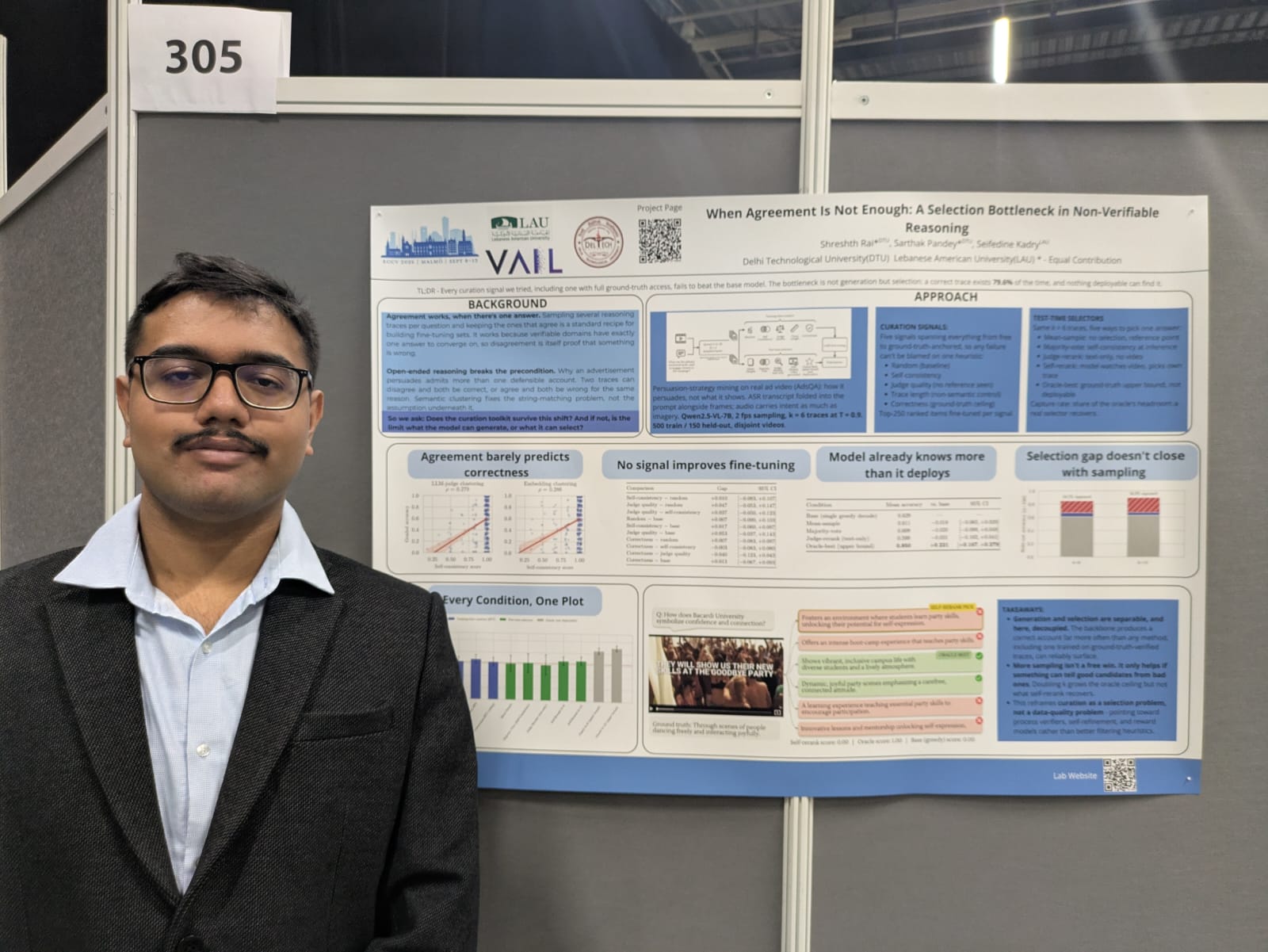
Presenting “When Agreement Is Not Enough” at the ECCV 2026 CDEL Workshop poster session.
Connecting with the community
Beyond our own presentations, Sarthak and Shreshth met researchers and faculty from around the world, exchanged feedback on each other’s work, and attended talks across the main conference and workshops. They came away with new ideas and connections that we hope will grow into future collaborations.
Thank you to the ECCV 2026 and CDEL Workshop organizers for a wonderful conference, and to everyone who stopped by our posters.